
Traceability and transparency are necessary to link specific products to specific sources – whether they be forestry operations practicing CSF or the salvaging of wood from an urban forest – enabling a direct connection between building projects and the people and forests that underlie wood used in construction. The insight that grows from this connection enables building project teams to identify willing partners and opportunities to link the wood in buildings to specific environmental, equity, and economic outcomes. It requires communication, trust and relationship-building between project teams and value chain actors, from distributors to manufacturers to landowners. Pilot projects conducted to date have clarified needs, identified what is possible for each partner, and elevated the broad set of values represented by forest managers and managed forests.
This guidance offers three Procurement Options for sourcing CSW that may entail different degrees of traceability and transparency. Option 1 addresses salvaged, reclaimed, reused, and recycled wood, Option 2 addresses certified wood, and Option 3 addresses methods for intentionally sourcing CSW in the absence of third-party certifications. While Option 2 (certified wood) offers more established processes for sourcing that can be reassuring and convenient, it does not necessarily require or deliver traceability or transparency. Option 3, however, does require a more rigorous tracing of wood to help validate claims that might be made about the management of source forests, absent certifications. This uncertified but intentional sourcing approach requires new and innovative ways to engage the supply chain and can actually strengthen claims of directly supporting landowners who are practicing CSF. In short, transparency and traceability underpin the ability to intentionally source CSW.
While traceability and transparency are important, implementing them can be challenging. This is because forest product industry supply chains are often complex. Materials are commonly mixed at different stages of distribution or manufacturing in ways that make direct traceability from an end product to one or more specific forests of origin difficult or impossible.
A typical wood product supply chain originates with a diverse combination of forest owners and harvest practices. Logs are received, sometimes through intermediary traders such as log yards that perform various sorts, at primary mills that process them into one of the industry’s foundational products: lumber, veneer or chips. These primary products are often used in secondary manufacturing: for example, lumber may be used in the fabrication of mass timber, veneer in plywood, and chips in pulp/paper, MDF, and particleboard. In some cases, secondary products are used in an additional manufacturing step: for instance, solid lumber, veneer panels (architectural veneer laid up on MDF), and hardwood plywood could be combined in the fabrication of an architectural millwork package. Adding to the complexity, there can be multiple steps in the distribution of materials, from wholesale to retail, and different types of products may have different distribution channels: softwood lumber and construction plywood used in building structures, for example, are handled by a branch of the industry that is separate from hardwood lumber and hardwood plywood used in interiors.
Figure 1 below depicts a relatively simple case where logs from a variety of landowners are processed into lumber by two sawmills and pass through additional value chain steps to be made into mass timber. A more complex illustration of wood product supply chains can be found in figure 2 in the section on disclosure.
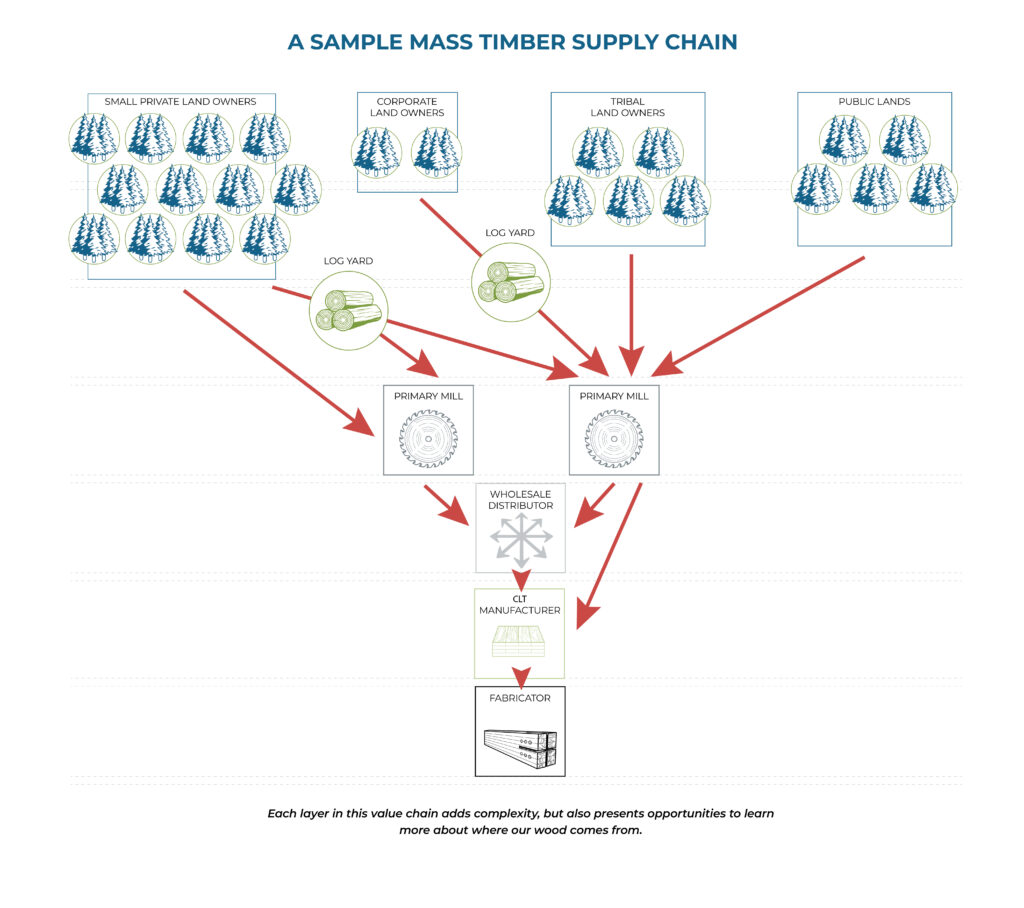
Figure 1
For all the above reasons, in many cases establishing traceability and transparency requires a commitment of dedicated resources; project teams who pursue them should be prepared to educate building owners about the need to underwrite the extra work needed to engage actors across the supply chain to secure their cooperation.
[1] Note, however, that mills that focus on cutting higher grade lumber track individual log sources more often than mills focused on high production rates. For this reason, beams and wood used for lamstock offer a better opportunity for projects asking for segregation of logs from specific landowners than do mills cutting for standard dimensional lumber markets.
[2] Custom purchase of lamstock happens more frequently for large custom orders while production from inventory occurs more frequently at mills fulfilling smaller orders and commodity CLT dimensions. Options for custom purchase are often limited to known suppliers to reduce risks.

©2026 Climate Smart Wood Group. All rights reserved. Privacy Policy