
When gathering information on traceability and transparency, project teams can adopt an approach suited to the level of disclosure desired. Regardless of the information-gathering method used, project teams should view themselves as a demand driver in the marketplace to draw out and partner with companies to create greater traceability and transparency in the forest products industry. It can be anticipated that with time and sufficient demand, an increasing number of wood product manufacturers and distributors will implement systems that make it easier to gather and provide desired information when requested.
Traceability information gathering starts with asking suppliers about their capacity and willingness to provide information that allows for tracking end products to one or more sources. It is linked to supply chain mapping but focuses on tracing individual products or batches of product either backward or forward through part or all of a supply chain map[1].
Aids to establishing traceability include:
Of the above, the most straightforward way to establish traceability for wood products today is through Chain of Custody documentation. It should be noted that Chain of Custody (CoC) documentation is not the same as Chain of Custody certification.
As described above, CoC documentation is basically a paper trail from the end product up through the supply chain. CoC certification, on the other hand, is a core component of forest certification systems like Forest Stewardship Council (FSC) and the Sustainable Forestry Initiative (SFI). CoC certification standards lay out a set of requirements that control the handling and processing of certified materials within and transactions of certified products between companies. Companies’ implementation of these requirements is verified through annual audits against the standard in question.
While all forest certification systems’ CoC standards require basic traceability procedures to help ensure that certified materials are accounted for as they move through the supply chain, currently none of them provide continuous or granular traceability through each stage of production and distribution[5]. Nor do any of them provide access to transparent information on the companies and forests that are upstream from a certified product.
While CoC certification is based on the auditing of documented systems and records, traceability refers to tracking the journey of specific lots of material through each step of the supply chain. In simple terms:
Transparency entails disclosure of information by manufacturers, mills, landowners and others in the supply chain, which is generally necessary to unlock traceability. Gathering the information needed for transparency can happen proactively, by engaging supply chain actors before making a procurement choice, or it can occur retroactively, by looking back up the supply chain after procurement has commenced to at least learn more about where wood has come from. Obviously, proactive transparency is necessary if a project team has intentional wood sourcing goals.
Unfortunately, many companies that are direct suppliers of wood products to building projects don’t know where the material originates, and even if they do they may resist disclosing what they consider sensitive information. The ask for information is often best made by a vendor’s direct customer whom they may know well and trust instead of by a project team member they are less familiar with (or in tandem). Information can be gathered with pre-procurement questionnaires, architectural specifications and/or reporting forms. Each of these methods typically rely on early engagement on the part of the project team with supplying manufacturers and mills. See the Project Phases section to learn more about how early engagement can enable proactive and intentional procurement.
In figure 2 below, suppliers can be asked to disclose information that can allow project teams to identify source forests that best match project goals and avoid sources that don’t. CSWG proposes three different levels and methods of disclosure:
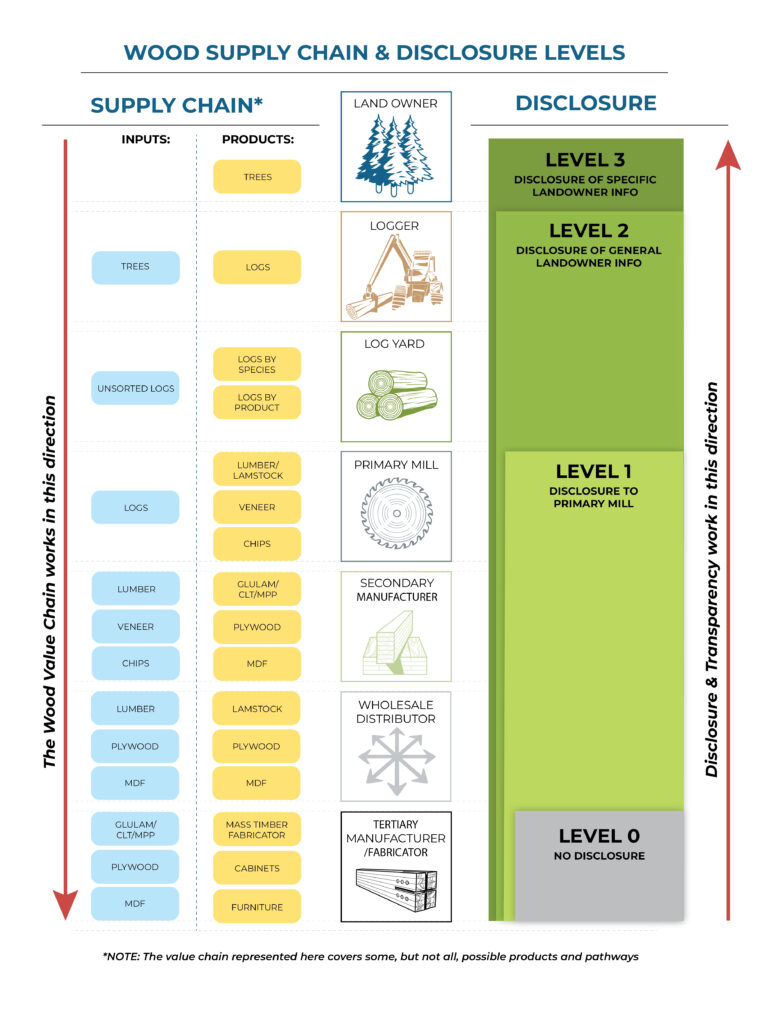
Figure 2
Sourcing material directly from specific landowners almost always requires segregation of logs at the primary mill, since that material would otherwise get mixed in production with logs from other sources. It is possible, however, to reward specific landowners indirectly through a mass balance system approach. For more detail, see the relevant section under Procurement Option #3.
Disclosure of supply chain and source forest information can result in a supply chain map: a schematic depiction of all of the supply chain links (manufacturing and distribution steps) from forest(s) of origin down to the final product. It is not necessarily obligatory, however, to identify all the intermediary companies between a Tier 1 supplier and a primary mill in order to achieve transparency around forest sources.
Urban, salvaged and reclaimed wood supply chains are often simpler: removals can be documented at the point of origin by cities, schools, or landowners, creating a transparent record before logs enter log yards or mills.
Moving toward more transparent and intentional procurement can take different trajectories.
Before launching into a transparency effort, broad buy-in is necessary, from the project client to the design team to the contractor, since the level of effort and commitment can vary based on the sourcing pathway chosen. See the Project Phases section to learn more about advocating for and collectively choosing sourcing pathways and levels of transparency that are necessary to make credible claims around the wood being sourced.
[1] While often discussed in similar contexts, supply chain mapping and traceability serve distinct functions in sourcing CSW and supporting CSF. Recognizing their differences is important, particularly in complex supply chains where the two must be strategically combined. Supply chain mapping is the process of documenting and visualizing the network of suppliers, facilities, and processes potentially involved in the production of goods across different tiers of the supply chain. It typically involves mapping suppliers tier by tier, providing project teams with a network-level view that answers “who” and “where” and helping them understand the potential actors in their supply chains. While this is critical for transparency, in and of itself it does not deliver traceability which enables end users to connect a wood product to or from the forest(s) of origin to the final product. Mapping identifies the universe of potential actors, while traceability validates what actually happened to a specific product or material within that universe.
[2] For more information, see Preferred by Nature’s Due Diligence Toolkit, DD 16 https://www.woodrisk.org/digital-supply-chain-management-tools
[4] However, there is a large and growing library of reference data for US hardwoods.
[5] This said, supply chains that have CoC certification may be better able to provide granular traceability since some level of tracking is intrinsic to the system.

©2026 Climate Smart Wood Group. All rights reserved. Privacy Policy