CSWG has collaborated with its technical partners to produce guidance about how to get better options and results sourcing climate-smart wood at each major project phase.
Owners and project teams have numerous potential motivations to use CSW in construction, including project ESG goals, improved tenant experience, and pro forma cost benefit, among others. The key is early engagement with project leadership and finding suppliers and/or other partners who can provide timely and accurate market knowledge, secure any documentation needed to validate claims about “climate smartness,” and ensure that wood products delivered meet expectations.
While much of the buzz around CSW centers on mass timber, it is important to remember that there are many more opportunities to incorporate CSW procurement in a project beyond the structural system or other mass timber components. Oftentimes, the nonstructural wood elements of a design are easier to source creatively since they are not as beholden to structural or code performance parameters. Do not overlook CSW sourcing opportunities for interiors, custom furniture, envelope systems, or landscape elements as these can serve as another engaging touchpoint in addition to structural systems for owners and their tenants.
It’s also understood that it may be challenging for project teams to strive for CSW if their project is already well underway. Even in those situations, consider implementing retroactive traceability to gain an understanding of where the project’s wood is actually coming from. Although not as ideal as proactive intentional sourcing, these kinds of activities can still be a useful first step for project teams as they move toward incorporating CSW into their practice.
Buildings that are designed to be built out of mass timber represent significant volumes of wood and potentially major impacts for the forests it is sourced from. Mass timber itself requires early engagement and careful timing when it comes to delivery. Procuring these elements with CSW requires an added level of rigor, but the pay-off for both the building’s story and the forests and people supplying the material can be extraordinary.
Projects that are considering mass timber as a structural system typically make a commitment to proceed at three different stages. In turn, these stages inform how CSW criteria can be applied:
A more detailed set of project phases (aligned primarily around mass timber projects) has been itemized below that will look familiar to design and construction teams. Within each phase, guidance has been provided to help implement intentional sourcing of CSW.
Of course, these phases can look a bit different depending on the project type and the contract delivery method being used. For instance, there may be inherent tensions within traditional delivery methods (especially in design-bid-build arrangements) where the final specification for timber elements are not released until sometime during or after the Construction Document (CD) phase. If the scope is bid from the final construction documents without earlier work to explore sourcing options with prospective CSW suppliers, then opportunities to secure the best set of outcomes may be lost.
Most mass timber projects, and especially those that are engaged in sourcing CSW, benefit from more collaborative construction delivery methods such as Construction Manager – General Contractor (CM-GC) or Design-Build (DB) delivery that engage the contractor and supply chain much earlier in the design and procurement process.
Figure 4: Regardless of the project delivery method, early goal setting and buy-in is essential ahead of formally beginning procurement in order to mitigate potential cost premiums, material availability challenges, and schedule constraints.
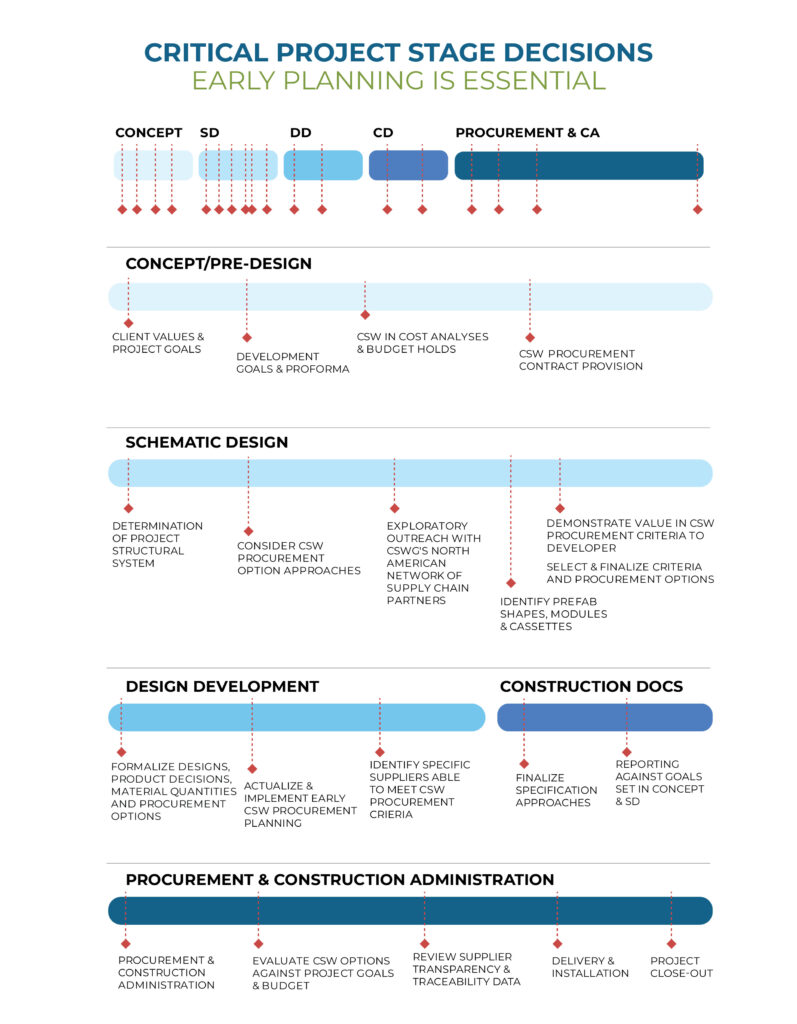
Figure 4

©2026 Climate Smart Wood Group. All rights reserved. Privacy Policy